Pages #61 through #120 | A North Korean graphic novel translated by Heinz Insu Fenkl


Giving Voice to the Korean American Community

Pages #61 through #120 | A North Korean graphic novel translated by Heinz Insu Fenkl
Budoji: A Tale of the Divine City of Ancient Korea (with an overview of Korean shamanism ~ By Jesang Park and Sungje Cho
(Alpha Sisters Publishing, 2023, ISBN #979-8-9869373-0-4)
Review by Bill Drucker (Winter 2024)
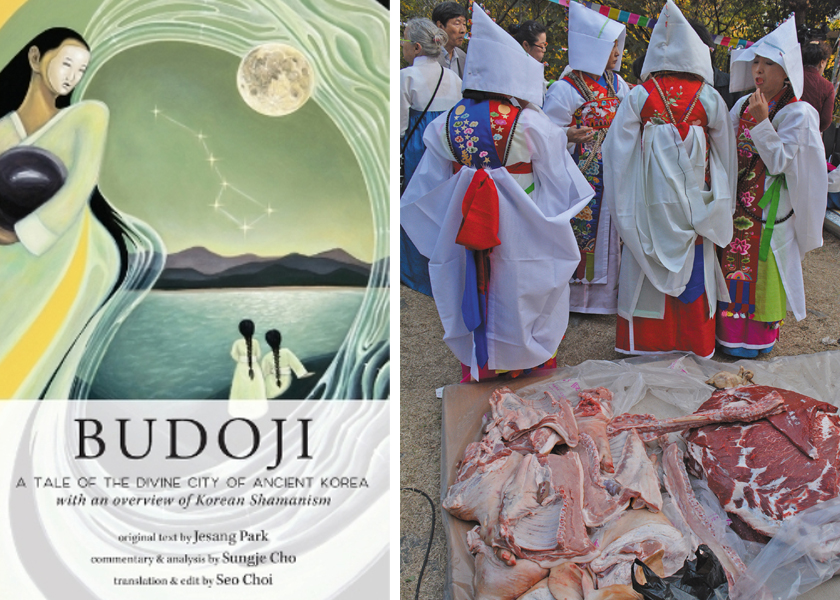
Every so often, a splendid little book comes your way. So it is with Budoji. Ancient myths and legends, earlier than the Dangun myth, come alive. There are stories of the earliest gods and goddesses, the creation of the universe, Earth and man. There are interesting parallels and similarities of ancient Korean myths with other cultural myths.
The original author of this work was Jesang Park (363-491 CE), an official of the ancient Silla Kingdom. In Park’s time, the ancient stories were already ancient. Some narratives of Budoji go back to 2333 BCE. As part of a 15-volume collection called Jim Shim Rok, the Budoji narratives have survived generations among Park’s descendants.
As part of the narrative, we learn that Park’s writings about ancient myths and legends were were brought from North Korea to South Korea in 1953. The 2023 Budoji version has been further updated and translated into English.
The word budo refers a capital city and also to a nation that exists in accordance with the divine, where divine ways or heavenly virtues are fulfilled on earth. The early beliefs in the divine were guided and interpreted by early priests or shamans, who influenced people’s cultural and spiritual lives, maintained the oral history, and practiced sacred rituals.
Budoji includes the earliest stories of the creation of the universe and humanity by the goddess Mago. Mago’s role is reminiscent of the goddess Gaia in the early Greek myths. In Magosung’s (or Mago’s) Paradise, humans lived in harmony. Eventually, humans migrated out into the world as four major clans. The book includes a story of the Great Flood. The flood is a shared event, actual or allegorical, among world cultures, notably the Sumerian epic of Gilgamesh, the biblical Noah and the ark, and can also be found in Greek and Hindu myths, and Native American tribal legends.
Budoji consists of 26 brief chapters with modern interpretations, and five appendices that provide a concise and informative description of shamanism. In Chapter 1, Magosung, the creation goddess of earth and humanity, sits at the highest place on earth. Chunbu or the divine ways reside there.
Mago and her two daughters give birth to four heavenly clans. Hwang-Gung, or the yellow clan, became the Asian descendants in Korean, China, Manchuria, ad Siberia. Baek-So or the white clan became the Europeans. Heuk-So or the black clan migrated to the Middle East and Africa. Chung-Gung, or the blue-skinned clan, managed the waters. The Chung-Gung clan later disappear.
Remnants of the Mago mythology are found in Nogodan, an altar to the earth goddess, located in southern South Korea on Mount Jirisan. Her name is recorded in the Goryeo Kingdom era records.
There is a narration of the process of creation, as in the Genesis chapter of the Bible. At first, there was only the sun, and nothing had shape. Eight notes of sound make up Yulyeo or the divine energetic forces or vibrations that create the universe. The divine sounds go on to govern the earth and the universe. Four heavenly men and four heavenly women control Yulyeo, the high pitch of yin (women) and the long echoes of yang (men).
The earth comes into being when Mago opens the heavenly waters and the earth took shape with the elements of air, fire, water and earth. The four heavenly clans manage the primal elements.
After earth is created, the goddess Magosung orders the four heavenly men and four heavenly women to procreate. Soon the divine world had more than 3,000 humans. In Magosung, humans consumed the divine earth milk.
One tale is of a man of the Baek-So clan who goes to the well to draw earth milk. He gives milk to other humans but forgets to take some for himself. At home he hears the the song of the grapes in the vineyard. Still hungry, he gorges himself on the fruit. He experiences Omi, the five flavor sensations of sweet, sour, bitter, salty, and spicy. Thus begins humanity’s break with the divine and its move to sensual earthly life. This tale of a human eating fruit in the garden has many parallels with the Adam and Eve story.
When humans left Magosung, the gods gave the clans a special talisman to remind them of the divine ways. The various talismans included a rattle, a mirror, and a sword – all ritual items used by the shaman to this day.
Budoji also recounts a familiar narrative of the Great Flood. The story goes that a thousand years after leaving Magosung, humans lost their divine ways. The clans became strong and waged war on one another. In heaven, Mago and her daughters used celestial waters to cleanse paradise. Some of the water spilled over to the east and west, causing a great flood on earth, which cleansed the earth of evil. In this narrative, water has a familiar role as a way to ritually cleanse and cause rebirth and redemption.
Numerology plays an important spiritual and symbolic role. Yulyeo force is a dual force of yin and yang. Other cultures developed ideas around duality; as in the opposing relationships of light and dark, or good and evil. The idea of three is developed in various ways, such as in the virtues of goodness, clearness and generosity. The idea of four also gains importance and is seen in the primary elements of air, fire, water and earth. A symbol, known as sigil, consisting of three smaller circles within a fourth larger circle; the symbol represents Mago and the Triple Goddess Samshin.
Similar symbols using three circles are found among the Druids, Buddhists, Christians, and Hindus. Numeric symbolism still manifests in modern spiritual practices and in superstitions.
The remaining chapters continue with an accounting of man’s destiny. After the great flood, Magosung moves to the Milky Way, putting more distance between the heavenly and earthly beings. But the gods did not abandon the humans. The sons of the divine descended to Earth for 7,000 years to maintain Budo and the divine ways. In the Korean culture, with its thousands of years of mythical, oral, and recorded histories, the virtues of the divine way, numeric symbolism, and ancient rituals are still very much alive in modern times.
The credit for the unique rendering of the ancient stories in Budoji begin with the original manuscript by the Silla official Jesang Park. His name is validated in another famous ancient Korean document, the Samguk Yusa (or the Memorabilia of the Three Kingdoms). The modern team that made this collection readable and approachable for an English-speaking audience includes the commentary and analysis by scholar Sungje Cho. Seo Choi was responsible for the translation, editing and publishing, and Korean American artist and poet Meesha Goldberg designed the book cover and illustrated the pages.
Gwangju Uprising: The Rebellion for Democracy in South Korea ~ By Sok-yong Hwang, Jae-eui Lee and Yong-ho Jeon
(Verso Publications, London 2022, ISBN #978-1-7887-3714-2)
Review by Bill Drucker (Winter 2023)
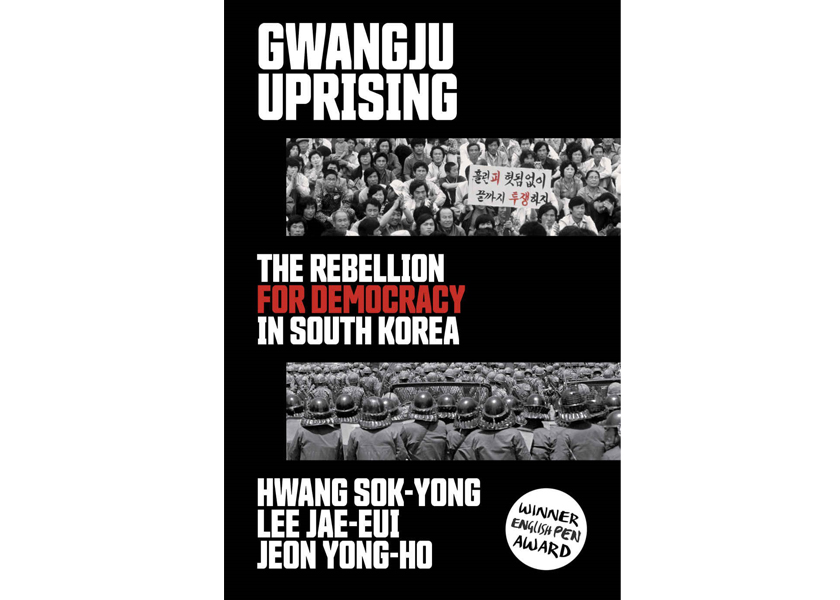
The violent and tragic events of May 1980 in Gwangju, South Korea are now a generation old. Forty-three years have passed since the South Korean military put down a largely peaceful uprising for democracy, gunning down citizens in the streets, while the government afterwards attempted to suppress and obfuscate the facts of the event.
The young men and women who participated in and witnessed the events in Gwangju are now mothers, fathers and grandparents. In many ways, this book is a legacy and a reference for their descendants.
The account reviewed here is a revision of the original, authored by Jae-eui Lee (and others who were unnamed at that time) entitled Gwangju Diary: Beyond Death, Beyond the Darkness of the Age (1985), which was based on the diary of eyewitness Jai-eui Lee and on testimonies of other witnesses he documented at the time. The book has sold more than a million copies and is considered the most important account of that historical event.
The revised edition, Gwangju Uprising: The Rebellion for Democracy in South Korea (Korean edition 2017), compiles and describes evidence and the course of events that adds to the original. Lee is one of the Gwangju Uprising editors. The English translation reviewed here was published in 2022.
The story relates how the events of May 1980, when citizens in the city of Gwangju demonstrated for democracy and were violently killed in the streets, were not just a historical moment, but a transition for South Korea from an autocratic to a democratic government, and a transformation during which it began to recognize the power of citizen voices.
The authors accuse the South Korean government of systemic information suppression of the Gwangju events. Much information has emerged since 1980, including survivors’ testimonies, film, photos, and physical evidence. The authors relate that the government downplayed and flat-out denied its actions, suppressed facts, and made unsubstantiated accusations of conspiracies to cover up the many unjust activities of that day and the days leading up to and following it. They also contend that the Gwangju citizen leaders were slandered as rebels against the state.
State denials of these contentions have boomeranged and have given strength to the Gwangju Uprising Revision Committee. The result has been increased international support and sympathy for uncovering the truth of that dark era.
A surge of renewed interest by many Korean people to uncover the truth prompted the government to dig itself in deeper – there were new efforts to dismiss the Gwangju writers and to suppress or destroy evidence.
In 2014, the Gwangju Uprising Revision Committee initiated an update to the original 1985 account. There was a plan to publish the revision by 2015, the 35th anniversary of the Gwangju Uprising, and to fund the work with private donations.
The project was slowed down by the mountains of new evidence needing review. This included oral records, court records from the trials of former Presidents Doo-hwan Chun and Tae-woo Roh, records of military deployment, declassified U.S. documents, and new testimonies of many witnesses, both Koreans and foreign journalists. Verifying the authenticity of the evidence and compiling it into a single volume publication would require a later publication date than originally planned.
During the post-uprising era, after May 1980, dictator General Chun squelched the people’s democratic movement, and held his grip of power until 1988. The government had attempted to prevent the original publication of Beyond Death. Consecutive conservative right-wing presidents, including past-president Geun-hye Park (daughter of military dictator past-president Chung Hee Park) have verbally attacked the Gwangju leaders and the book authors.
The recent Gwangju Uprising (2017, with English translation 2022), in three sections and 15 chapters, describes how citizen unrest and several events between October 1979 to May 1980 changed the South Korean political landscape forever. After Chung-hee Park was assassinated (October 26, 1979), there was an opportunity for a civilian government to emerge, but the conservative elite scrambled and managed to maintain autocratic control.
In the power vacuum, Defense Security Commander Doo-hwan Chun emerged as a leader, first as director of the South Korean Central Intelligence Agency (KCIA), then as the new military dictator president. He positioned military all over the country, on campuses, and at suspected hot spots of political activity. Gwangju was largely an agrarian region with a central city on which there were college campuses. It was also a center for anti-dictatorship activity. Suddenly, military bases, ammunition depots, and troops arrived and were stationed in and around the town.
There were sporadic and passive resistance activities in opposition to the military crack-down, then on Sunday, May 18, the Gwangju Uprising officially began when armed and unarmed protesters outnumbered local troops by tens of thousands; the troops backed down. Gwangju citizens declared victory on Wednesday, May 21.
In the subsequent escalation, well-armed elite South Korean troops and paratroopers were sent in. An effort to negotiate ended in an impasse. The South Korean government treated the Gwangju uprising as a national crisis. Troops blockaded the city to cut inhabitants off from food, energy, and services, and from reporting the events to the world.
Citizens responded by further arming themselves, some by raiding armories for weapons. Public buildings became makeshift hospitals and refuges. The situation further escalated as soldiers shot at armed civilians.
Military attempts at blockades failed and civilians broke through. The killing escalated. When there was finally a ceasefire, the military leaders feared that news of the slaughter would result in national condemnation. The government attempted to cut off the South Jeolla provincial region from the rest of South Korea, mainly to buy time for the state to come up with a way to justify the troop violence in Gwangju to the populace.
On Thursday, May 22, the fifth day of the uprising, the people of Gwangju declared liberation. The troops retreated. A citizen-led ad-hoc government moved into Province Hall. A Settlement Committee was established, and for a few days, the citizen-led government dealt with the emergencies in the post-battle city. The leadership team also formed a Democratization Committee.
There were still firefights and skirmishes to be controlled. Dead bodies had to be identified and buried, and wounded people need care. The Red Cross was allowed to enter Gwangju to help. Communications and negotiations were re-established with the troops and with the national government in Seoul.
On Monday, May 26, Republic of Korea (ROK) troops and paratroopers positioned themselves outside the city, then swept through Gwangju and neighboring towns, killing unarmed citizens.
On Tuesday, May 27, there was a final battle with paratroopers. The rest of the story remains incomplete. The actual casualty count is unknown, but estimated at being between 200 and over a 1,000 civilians being killed – it changes depending on what party is producing the numbers. The number of missing people is also unknown. Unmarked graves were eventually located and many bodies were recovered, marked, and recorded by the martial law authorities.
In 1981, the Korean Supreme Court commuted the sentences of 83 defendants who were convicted of insurrection. The few charged with death sentences were given life in prison, and others charged with life sentences had their sentences reduced to 20 years. Later, most were given special pardons.
In 2001, a Gwangju Uprising Missing Persons Truth Commission was formed. Details in the appendices of this book describe how the commission had bodies exhumed from 47 sites, and checked for any evidence of cause of death. Some of the dead were identified with newer forensic technology, such as DNA matching. More than 300 people are still considered missing.
Nearly 20 years of citizen advocacy for justice was rewarded with a trial before the South Korean Supreme Court. As a result, leaders Doo-hwan Chun and Tae-woo Roh went to prison. Ironically, democratically-elected President Dae jung Kim (1998-2003) who was a target of oppression by both Chun and Roh, would pardon the two convicted past-presidents. Gwangju Uprising groups railed against President Kim for this action.
The Gwangju documents were submitted to UNESCO for preservation in May 2011. Gwangju Uprising was the recipient of an English PEN literary award for translations of important foreign language works into English.
This book celebrates the courage and tenacity of the people, particularly the brave writers who persevered during an era of an oppressive dictatorship, and recorded the struggle for human rights, freedom, and against a succession of corrupt leaders, and the witnesses who boldly came forward during that era to tell their stories in an environment of oppression and fear.
On an organic farm in Korea, a volunteer has the chance to learn more about Korea and herself | By Sara Salansky (Winter 2023)
Every time I go to Korea, I try to have a goal for what I want to experience or accomplish.
This time, I decided to let my trip dictate what would become my experiences or accomplishments. I built a basic itinerary, mainly so my family would know where I would be throughout my month-long visit. I made a list of must-see people to visit, places to see fall colors, and plans to volunteer at an organic farm. That was the extent of my planning. For once, I left the goals open-ended.
In the back of my mind, I am always trying to learn something new about Korean culture with each visit. I have developed the belief, over successive visits, that we Korean adoptees should visit our birth country with open minds. We need to take the good with the bad, and hope that we can see more good than bad in our motherland.
There are a lot of aspects of Korean culture that I am ashamed of and wish did not exist. Although I know I cannot change these negative qualities, at the same time, I feel I can make my own small differences by interacting with fellow Koreans on a personal level. That kind of small change, helpful or meaningful interactions that can only happen person-to-person, is what I think I accomplished with my most recent trip. It hit me, after mentally processing the personal meaning of this recent trip, that the primary theme was “one is never too old.”
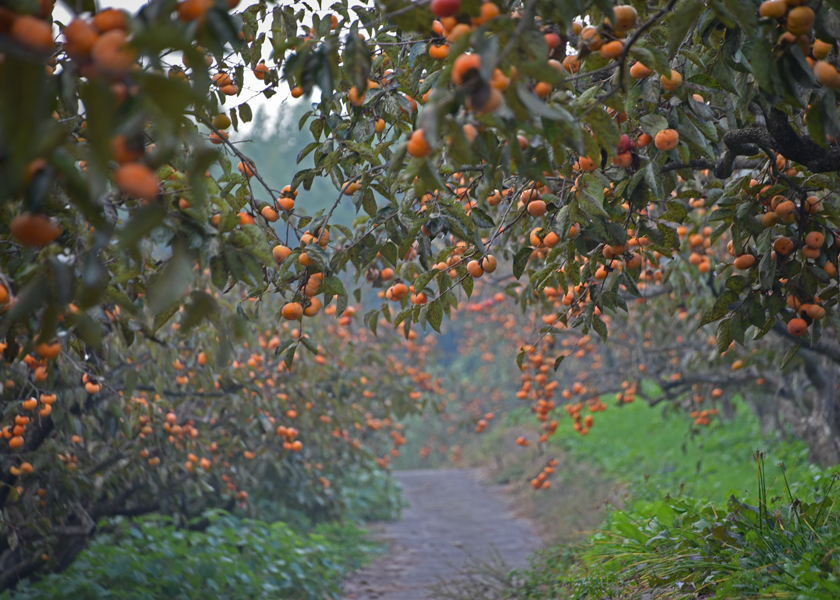
One of my adventures during the month-long visit, was a trip with KQ photographer Stephen Wunrow to work at an organic persimmon farm through the Korea branch of the international Worldwide Opportunities on Organic Farms federation (WWOOF Korea). WWOOF is a 50-year-old federation of associated organizations. Working in more than 130 countries, it places volunteers on organic farms with hosts who need help and want to meet new people. The hosts provide food and housing for volunteers during their stay.
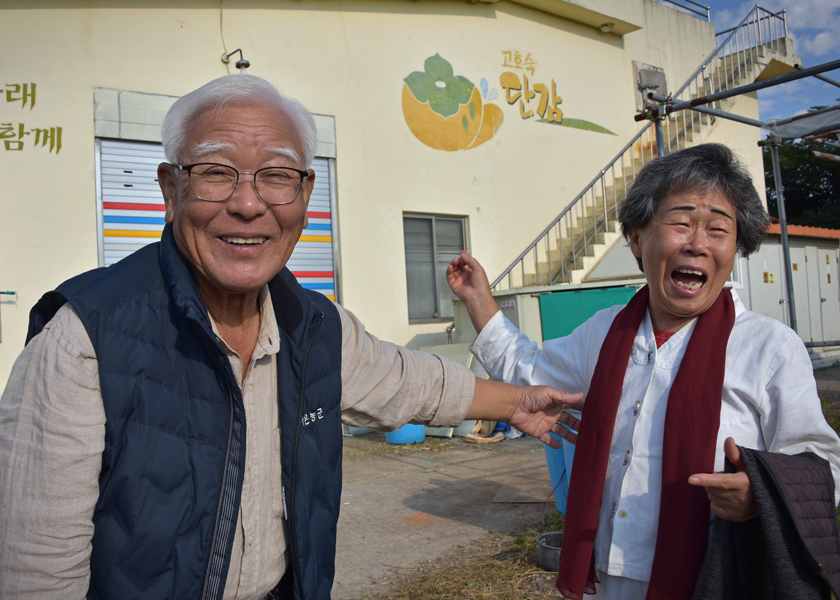
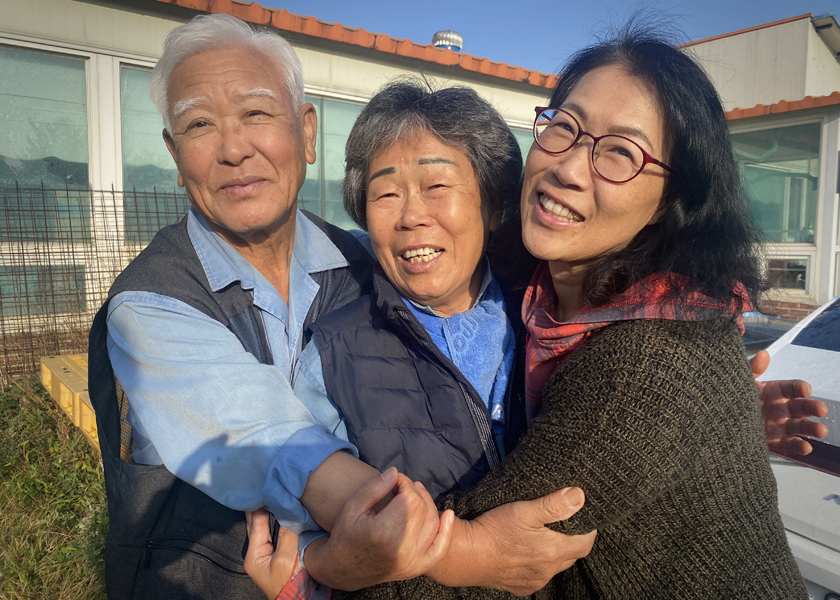
Our WWOOF hosts were a couple who have been married for more than 50 years. They became farmers since 1977, when they purchased the Lohas Farm in Sinbuk, Jeollanam-do (near Naju) in the southwestern corner of South Korea.
The wife of the farming duo, Hyo-sook Go, became our master teacher. She received both her Bachelor’s and Master’s degrees in food engineering from Mokpo University. As a part of training for her role as a WWOOF host farmer, Go participates in an on-line English class every morning at 7 a.m., after doing yoga. Her level of English was sufficient for conversing and for receiving our marching orders for the day. We also relied on Google Translate. Thank goodness for technology!
Husband (Mr. Jeong) had no facility in English, however, this was not much of an impediment to his communication because of his outgoing and hospitable manner. Jeong was a career military officer and achieved the rank of colonel; Go supported him during these years. While living in Seoul, the two decided they needed to change their eating habits. Go had developed a rash and believed it was because of ingesting a chemical on or in the vegetables she was eating. In their search for clean, untreated food, they decided 28 years ago to move to the countryside. Jeong retired, and is now supporting her dreams of living on and working the land with sustainable practices.
It was daunting to watch this power couple work together every day, producing products they are passionate about, and growing other foods for their own use. Go and Jeong grow persimmons and make products in their own farm facility from their own fruit, as well as from imported organic fruits. In addition, they harvest wild mountain herbs to make an herbal drink extract; collect wild mulberries to make a probiotic beverage extract; they produce vinegars with active enzymes; and they also collect and process ginkgo nuts and several other products that enhance the immune system and the gut.
Jeong is now age 80, and Go is 76. The couple have no children, and they run their farm almost on their own, with intermittent (unskilled) help from WWOOF visitors like us. However, they have earned immense respect in their community so when they have big farm jobs to do, area residents come to help them when they ask. Age clearly does not matter for this power couple. Their active lifestyle and good health make them living examples of how their products can help others live healthier lives.
During our visit, they told me that they are just getting back to having volunteers again. For two years, they functioned as a two-person operation because of restrictions posed by the COVID pandemic. This fall was the first harvest season since 2019 that they have had volunteers to help with the persimmon harvest time, a very short and labor-intensive season.
Every time Go and Jeong open their farm to volunteers under the WWOOF program, they open themselves to new people, new personalities, new opinions, and new work ethics that can affect the success or failure of their farm and business.
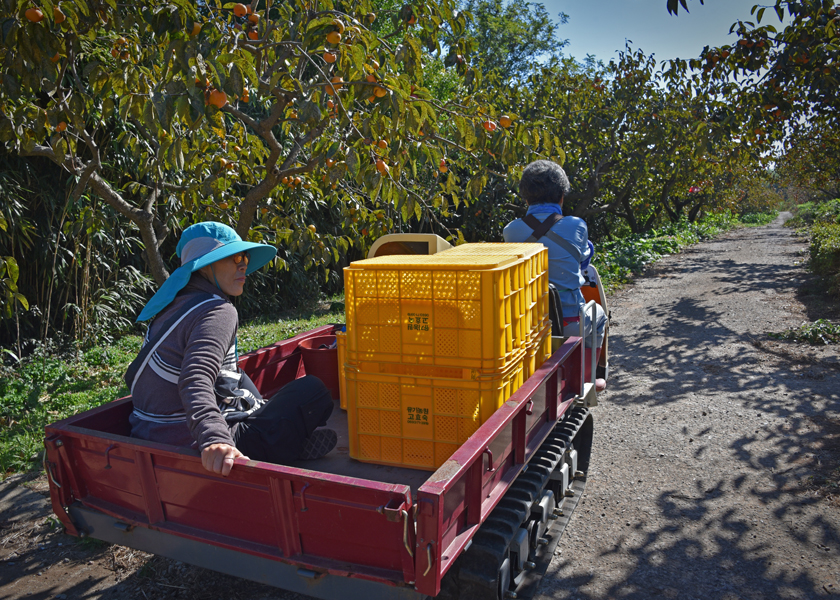
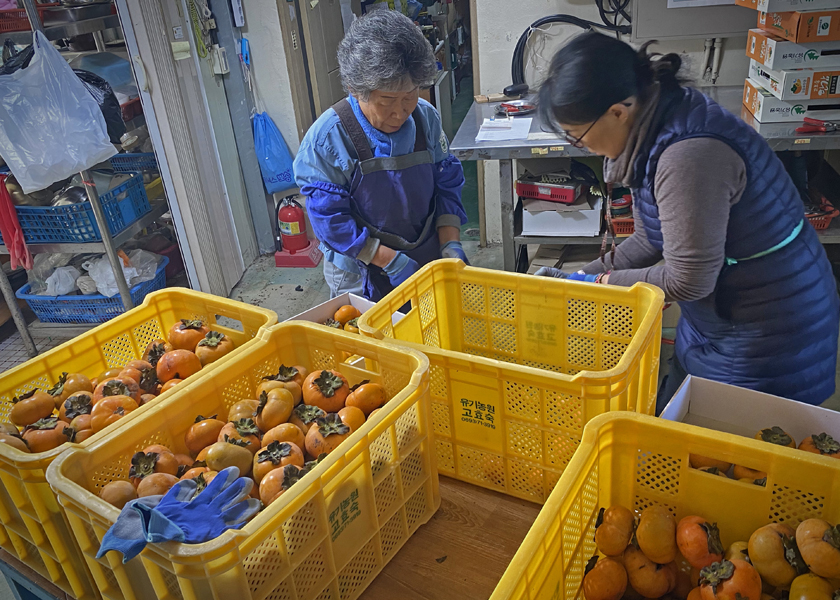
On our first full day, we got the crash course on how to pick persimmons, clean them, and pack them into boxes. Not realizing that there was a deadline, we were enjoying our learning experience. When 4 p.m. hit, we were told that the boxes needed to be packed and delivered by 5 p.m. It was 5:30 that day before the truck could leave for the distribution facility.
We stayed at the farm to enjoy the amazing sunset, oblivious of what was going on at the distribution site with our farm hosts. We ate dinner late, and when our hosts returned, Go was visibly upset and did not even want to sit with us, because she had been crying. She eventually joined us as we were cleaning up from dinner, and told us that it took a lot of hard work and a lot of yelling but she was able to sell all of the 30 boxes we had packed.
On the second day, we were prepared. I worked with a new-found sense of purpose that our hosts’ business reputation was on the line, and it was up to us to come through. Even with my experience of growing up on a farm, and volunteering on a local organic farm in my home state, I felt more stress in those two days of harvesting more than ever before.
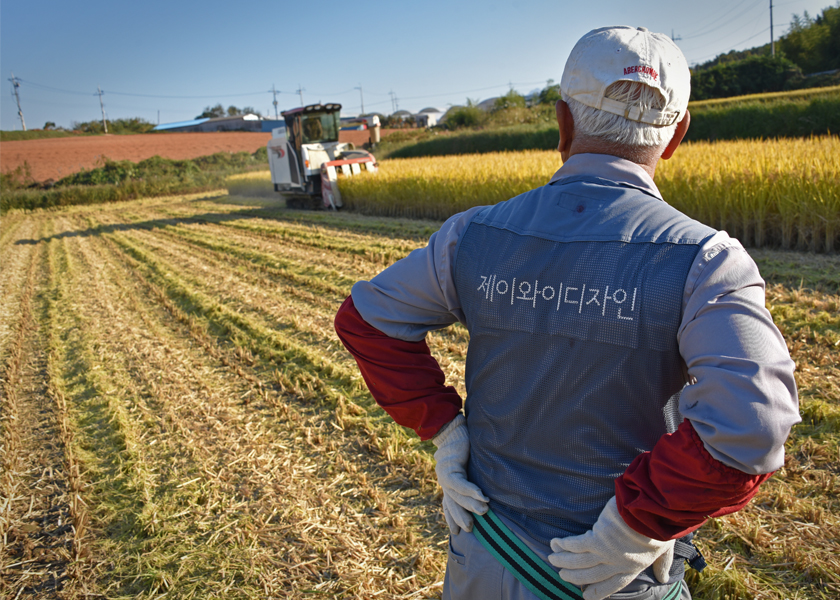
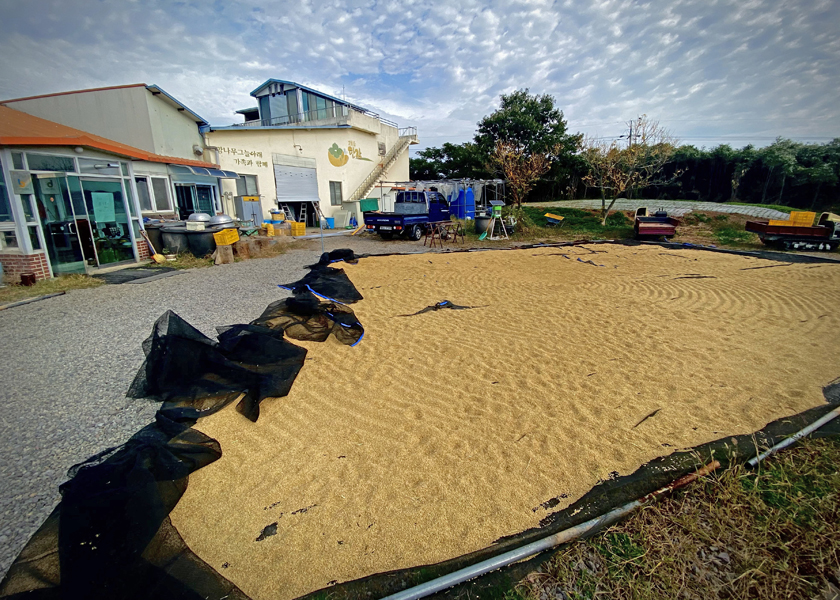
On the positive side, we learned a great deal about organic persimmons and the entire process of picking and cleaning, putting the boxes together, and filling the boxes according to strict standards. On top of that, there were rice-harvesting tasks, and an assignment to lift and move heavy boxes of bottles to store in a more protected area of the farm facility (that was Steve’s job).
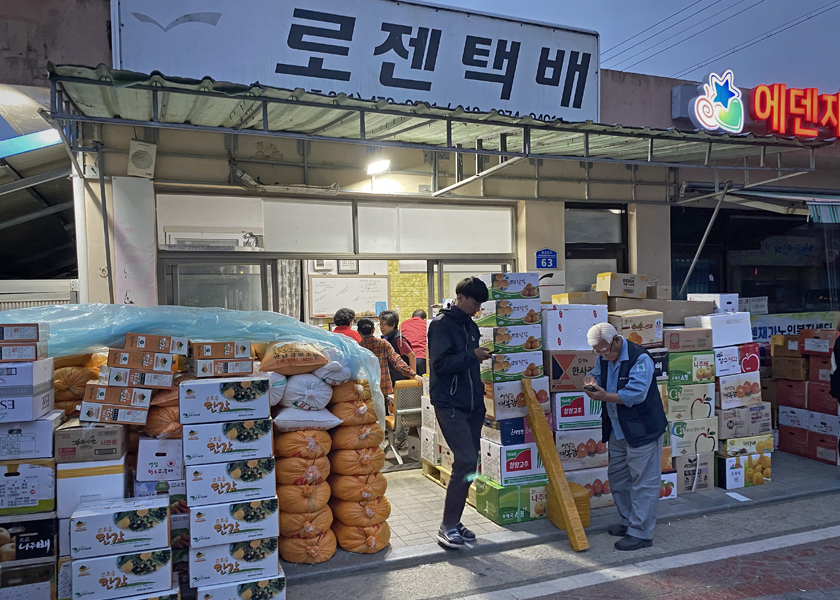
When 5 p.m. came on Day 2, all the boxes were packed on time and ready for transport in the little SUV. We rode along and saw firsthand what happens at the distribution facility; we also witnessed the additional stress the couple go through when not every box of the perishable fruit is sold at the site. The two were phoning prospective buyers as late as 7 p.m. trying to get the day’s harvest sold.
I reflected on Go’s daily schedule – a 76-year-old woman who gets up at 5 a.m., does yoga, makes breakfast, and takes language class at 7 a.m., then works until 5 p.m. with no nap or real break. How many of us can do that every day?
Day 3 (Saturday) proved to be even more stressful. We were invited to sit in on two business meetings about a new venture for Lohas Farms to sell their vinegars and health drinks in the international market. They asked us to sit in on the meetings so that we could rewrite their product labels in English using international trade standards for labeling. We felt more useful in doing this task, using our English language knowledge and editing expertise to help the business in a way that the hosts really needed.
Finally getting home at 11 p.m., we were exhausted, but the work still wasn’t done as we had to find the files to translate to English and get clarification of what needed to be accomplished. They told us that, oh, by the way, they needed the finished product by next Thursday. Talk about stress. It was fortuitous that we were volunteering during those crucial days of harvest, and at the start of the new international sale campaign. True karma – it’s the only way to explain it.
The four days spent with Go and Jeong reminded me that we are never too old for a new venture, and that if we put our minds to a problem, even if there are failures along the way, we need to keep trying, and keep doing what we want to do. Striving and trying new things keeps people young. Our farm hosts were testament to that.
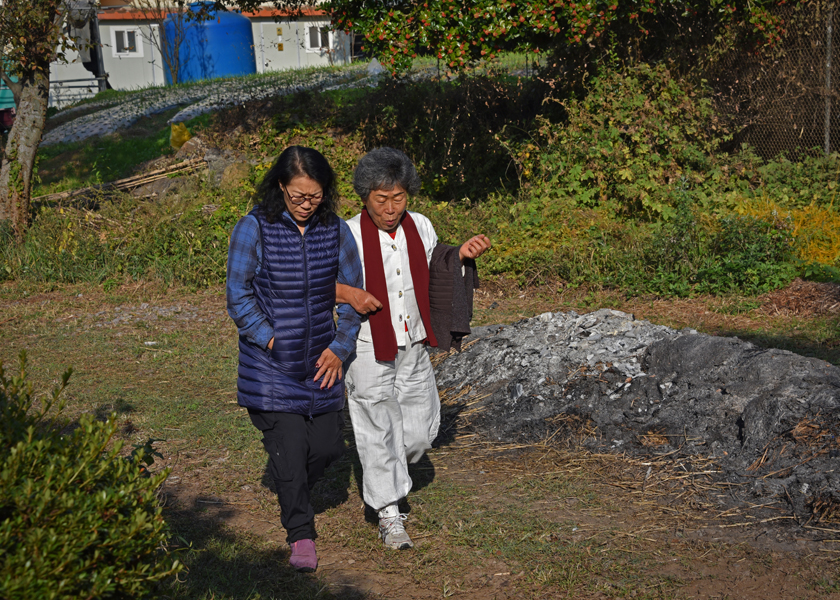
I’m so glad I volunteered with WWOOF and met this wonderful couple. This experience also solidified my desire to start a project to invite foreigners, particularly Korean adoptees, to volunteer on organic farms in South Korea.
The project will be called WWOOF With Us. It will be structured to pair up experienced Korea travelers who are previous WWOOF volunteers with newcomers who have either not been in Korea or have a fear of navigating Korea. WWOOF With Us participants will get a hands-on learning experience on an organic farm, and will also get some guidance in Korean culture, particularly with Korean rural life and organic farms. More information will be coming out in the new year as I fine-tune the program with WWOOF Korea.
As one of the senior members of our global Korean adoptee community, it was good for me to realize that there are more senior people than me in the world embarking on many new adventures. Particularly for Korean adoptees, it is good for us to realize it is never too late to visit the motherland, to study Korean culture, to learn new things, start a new venture, or help someone else overcome their fears. It’s never too late for us to open ourselves to understanding the beliefs of others, and to explain our beliefs to a person from a very different culture.
At its best, both leisure travel and volunteering are about opening ourselves up a new adventure. Volunteering our services in a different culture requires a special way of accepting and going with the flow, but with guidance from services like WWOOF With Us, even inexperienced participants will be able to help out organic farmers with needed labor, while experiencing the beauty and hospitality of Korea.
Sara Salansky is planning to participate in WWOOF Korea again from July 17 through 25, 2023. To join her or to hear more about participating in WWOOF, contact her at: to************@***il.com
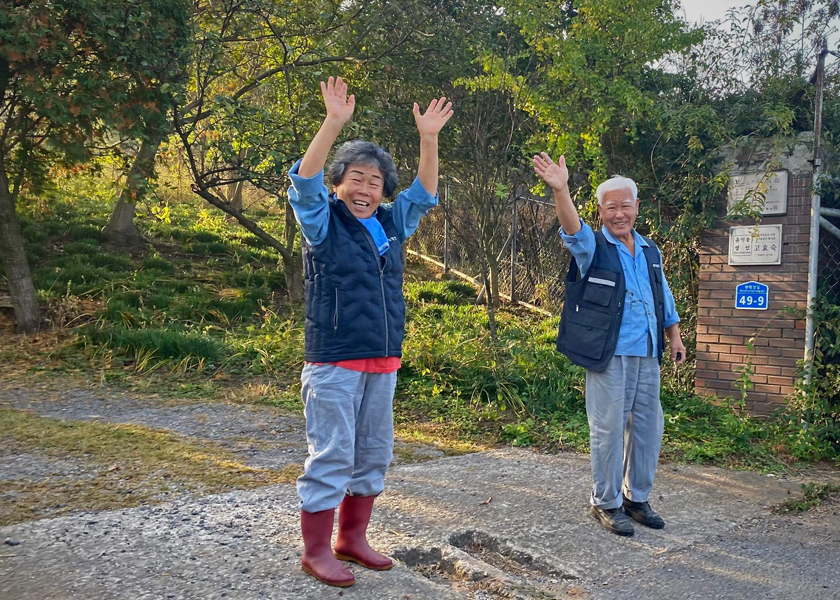
The lead-up, the loss and the legacy of the Itaewon Halloween tragedy | By Tom McCarthy (Fall 2022)
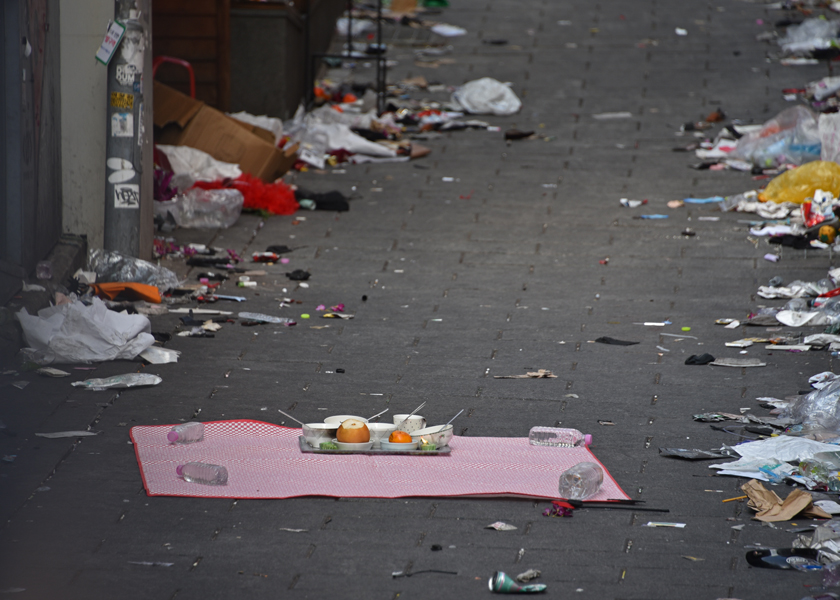
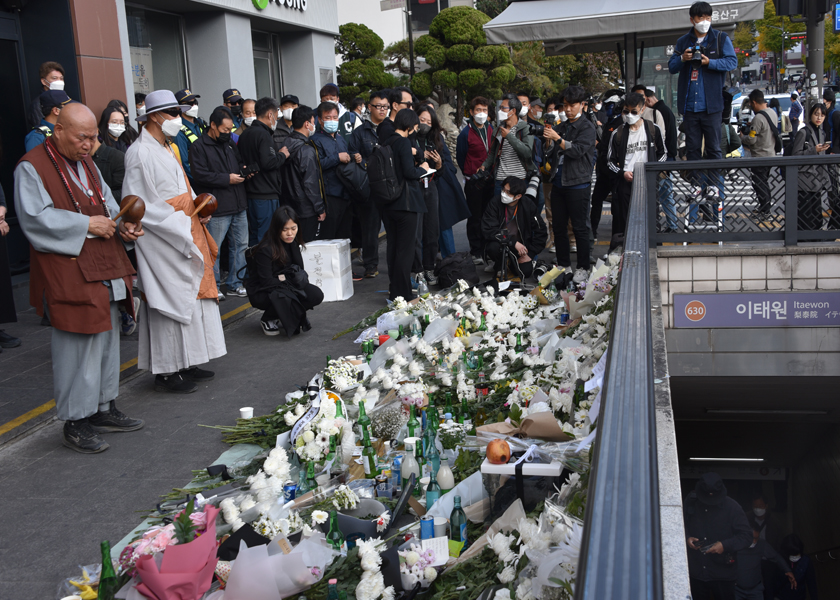
The scenes from Itaewon’s Friday night Halloween festivities and the disaster that followed have been splashed across front pages and screens around the world, the tragedy rocketing to the top story position on CNN, the BBC, and Le Monde.
As of Tuesday evening, November 2, 156 were dead and 151 injured.
Twenty-six foreigners and six underage students were among the dead, and there was an almost two-to-one ratio of women to men who were fatally injured.
The details have been rehashed ad nauseum: roughly 130,000 people, according to South Korea’s interior minister, most of whom were in their 30s or younger, descended on the “foreigner district” for likely the second biggest annual party night in Seoul after New Year’s. On Saturday, the neighborhood was patrolled by 137 police, a ratio of one officer for every 100 partygoers.
Halloween in Itaewon got global awareness with the success of the 2020 K-drama Itaewon Class; in the second episode, the characters are shown reveling in the festivities. In a genre known for injecting artificial drama and exaggerated plot points, the most unrealistic aspect of that series may have been the depiction of Halloween in Itaewon, with cameras chasing the characters as they caromed through the streets like balls in a pinball machine.
For the past six years, I have made a pass through Itaewon on Halloween weekend, and it has never looked like that.
The density of the crowds has always resembled, to a lesser degree, the harrowing footage recently projected around the world by international news agencies. I always felt a sense of imminent danger in that neighborhood on Halloween weekend, though it seems that not everyone considers it such a risk.
The one aspect the drama captured accurately was the liveliness of the evening. Costumes range from cute and sexy to funny and authentic, with some verging on Hollywood-quality design, with animatronic parts, sensor-activated lights and sound effects. The outfits are definitely worth seeing against the backdrop of pulsing neon, glimmering signage and ear-shattering electronica. It is an experience unlike any other, and that is what draws throngs of people from around Seoul, the country, and beyond.
On Friday night at around 8:30, the night before the disaster, I joined some friends to soak in that festive atmosphere once again. It was the first all-out celebration since the pandemic-related restrictions toned down all celebrations during the last two years.
With each passing bar packed to capacity, we retreated down a narrow alley linking the main alley and the main street, and stopped into a familiar bar to enjoy the easy access to quick service and sights of the main street from the comfort of padded seats. Though undeniably less crowded than the main alley behind us, the views of the avenue offered a taste of what was to come the next day.
This district was once known as a sort of frat row for U.S. soldiers from the nearby garrison before slowly evolving into a cosmopolitan food and club area. It is laid out like a ladder. The main four-lane avenue running almost perfectly from east to west is paralleled to the north by a narrower street, essentially a wide alley, lined with countless bars and clubs. “Rungs” of narrow alleys ranging roughly from 10 to 25 feet wide link the two east-west routes on what the news has described as a “hill” but would more aptly be described as an incline from the main street to the main alley.
We stayed at the bar watching increasing numbers of costumed partiers pour into the alleys transporting entrants to the alternate reality above until around 11 p.m. before we headed out. Hanging a left, we walked up the incline and turned right onto the main bar alley and work our way east, toward the site of what would be the fateful intersection.
I was unfortunate enough to find myself behind a friend who, though I love him like a brother, drives me to the brink of insanity with his unique talent of always preventing any form of silence, welcome or awkward. As we inched slowly down the road, he couldn’t help but frequently come to a full stop so he could turn around and make an observation.
Every time he did so, I could feel the compression build up rapidly against my back as columns of people log-jammed behind me. I felt the stress building up inside me as I barked at him to shut the hell up and keep going. We were about a quarter of the way down the main alley when my friend decided to turn off and head out to meet his girlfriend, jostling his way through the same side alley directly (to the west of the Hamilton Hotel) that would make international news a mere 24 hours later. I continued on behind the rest of our group, thinking to myself, “I’m too old for this shit,” as I watched him work his way down the small passageway not yet littered with festive rubbish or packed with helpless souls.
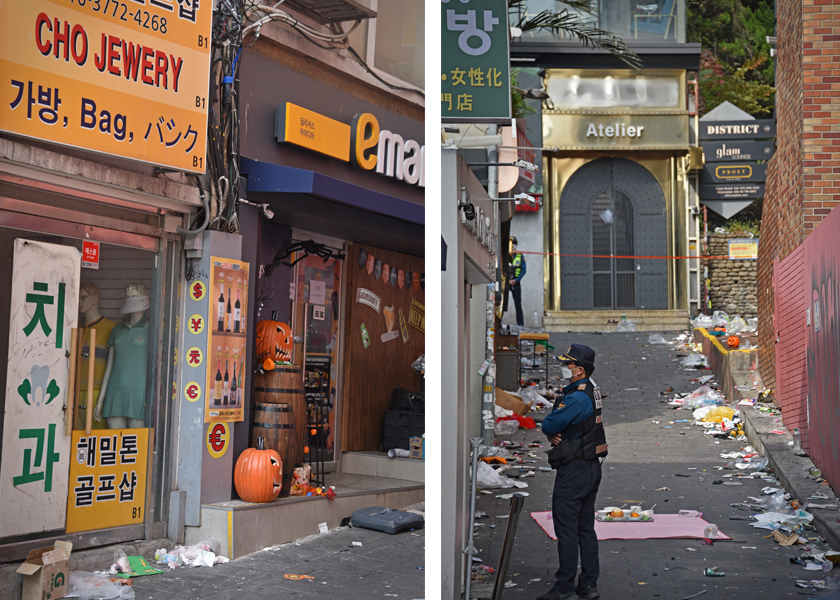
It has been revealed, through emergency service call transcripts, that as early as 6:34 p.m. Saturday, some four hours before the full-on emergency, police received the first report that the situation had the makings of a terrible accident. Calls kept trickling in, a total of 11 in the four hours before the emergency was declared. After the first four calls, the dispatchers replied that officers were already on the scene, and took no further action.
It was at around 10:22 p.m., after the situation had spun out of control, that emergency services swung into action. Bodies began piling up at the end of the small, now infamous “ladder-rung” alley adjacent to the Hamilton, and the initial first responders began trying to first pull victims out from the bottom of a pile. One responder described as a pile “seven, eight – no, 10 – rows of faces” high. Witnesses reported that those at the top of the incline fell first, which created a cascade of falling people, who became the heap of bodies at the end of the alley along the main street.
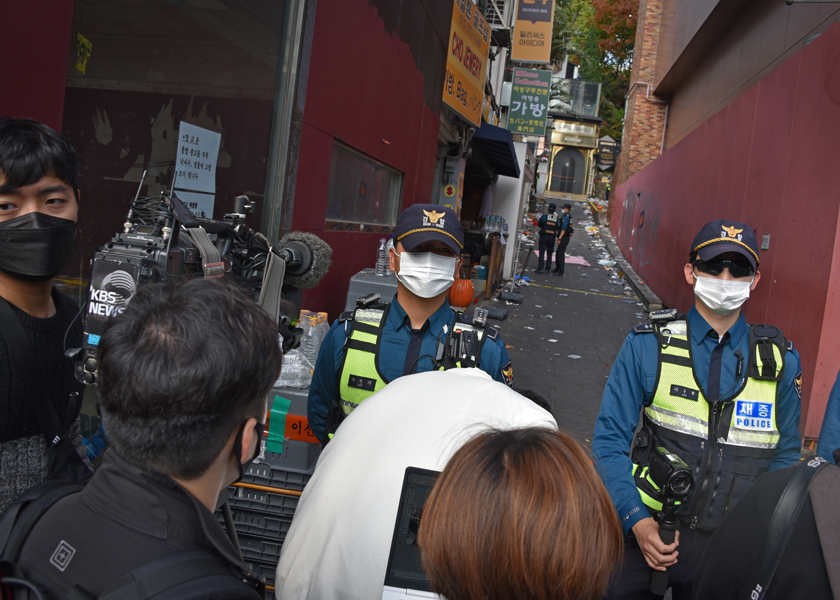
Within an hour, bodies were being laid out along the main sidewalk, and then on the adjacent street, where police, paramedics and firefighters were joined by Mario, Ronald McDonald and the Joker in performing CPR. Seemingly unaware of the gravity of the emergency, perhaps assuming it was a medical emergency for paramedics to take care of, or bar fight to be handled by the police, passers-by continued to party and watering holes continued to pour drinks.
Emergency responders began to remove injured victims as quickly as they could, sending them to and any hospital that had space. The victims left behind possessions such as ID cards or cell phones as well as shell-shocked friends who were not informed where the victim was being sent. This led to mass confusion for families trying to find their loved ones, a problem exacerbated by time and distance for the parents of foreign victims.
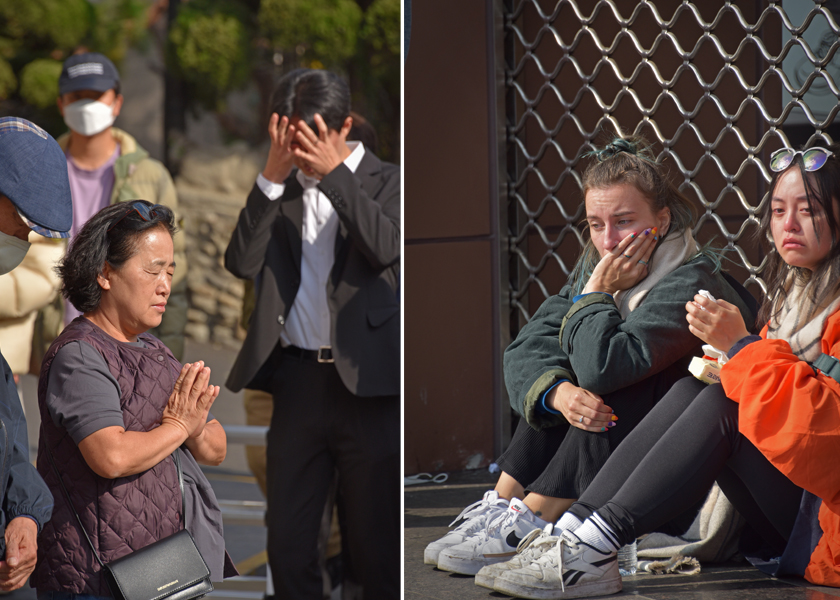
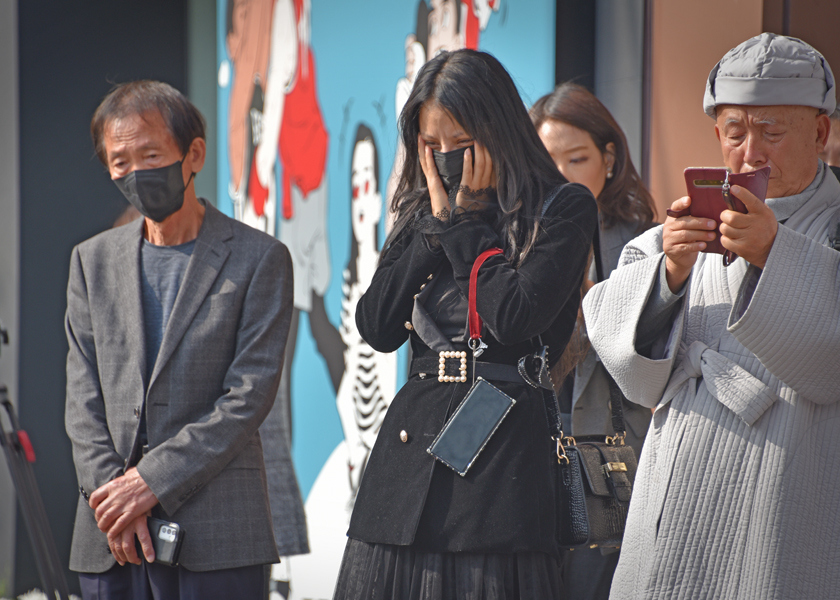
Families flocked to Seoul or sat by their phones thousands of miles away, waiting for a glimmer of hope. For the families and friends of the 151 or more people killed on Sunday, that hope never came. So many lives were lost, not to a terrorist attack or a structural failure, but to something more mundane – a crowd.
Whether chalked up to inadequacy, ineptitude or arrogance, how are these families supposed to make sense of this loss? How can the 35 million won offered by the government (about $24,500, a substantial sum in cases like this by Korean standards) possibly come close to compensating for a lifetime of experiences taken cruelly from not only the victim, but their families and friends?
What has made this disaster all the more distressing is the excruciatingly slow devolution of the entire situation. Calls came in for hours preceding the tragedy, but the police dispatch apparently did virtually nothing in response. Within hours, Interior Minister Sang-min Lee came under fire from his own conservative party for claiming that the size of the expected crowd was not statistically large enough to merit a stronger police presence. Indeed the 137 police initially on patrol were a substantial increase over the 37 to 90 officers dispatched during similar festivities before the pandemic, all of which went off without a hitch.
This is not to exonerate preparations on the minister’s watch in any way, although evidence now indicates that there was absolutely a systematic breakdown. However, a devil’s advocate may argue that without eyes on the ground, dispatch likely assumed the weekend was unfolding like every other Halloween. The police on site may have felt that their numbers were adequate, and surely had no expectations that a disaster of this magnitude could possibly unfold. Initial evidence indicates they were unaware of the incoming distress calls fielded by dispatch in the hours before the incident, they were able to react only after it was too late for too many.
There was little to be done anyway, with no police presence to be seen along the main alley, according to witnesses. It would at first have seemed unnecessary with the aimless and multidirectional crowd resembling the most densely packed game of Asteroids imaginable. However, compared with past similar festivities, these crowds were not at any greater risk than at any past events of this size. Strings of friends shifted at a crawl through the throngs of equally slow clusters of people, moving with only a general sense of direction, carried along by the ebb and flow of the crowd like leaves in the ocean.
It seems that the crowd grew and became more compact as the masses converged on the three-way intersection on the Hamilton Hotel’s northwest corner, a crossroads that offers the most efficient access to the most popular bars on the street. The compaction was gradual to the point of imperceptibility, leaving those in the middle of it with few options. Videos show one guy scaling a storefront to perch on a sign, a move many apparently thought was just Halloween shenanigans; there were phone videos of the climbing man who had clearly grasped the peril at hand.
Finally, the streets hit their breaking point. Some witnesses have claimed they heard young men at the top of the incline yelling “push!” The allegations are unsubstantiated as of now – if they are found to be true then the perpetrators should be subject to the full force of the law – but the descriptions by witnesses make it sound like there was no malicious intent, just tragically mistaken, and regrettably, alcohol-induced enthusiasm, and a shocking disregard for crowd safety that is all too common in a metropolis of 25 million people.
And therein lies the existential devastation of this accident, beyond the juxtaposition of people in fun costumes begging for help beneath a heap of unconscious bodies. The police received ample warning that the situation was devolving into a tragedy of terrifying proportions, but the system suffered a catastrophic failure. The police dispatch seemingly failed to impart the urgency of the situation to on-call responders. If forewarned, officers on site could have called for backup to re-route people to safer and less crowded routes.
In hindsight, all the risk factors were there for a crowd-compression disaster. But it is easy to understand, especially having been there the night before, how so many chose to ignore the signs. There was probably nothing out of the norm for a Halloween night. People were swept along with the crowds and the fun until they were in a crush that was too deep to escape.
We typically think of crush incidents as taking place in stadiums of rival fans, where the accident is preceded by scenes of angry football hooligans spewing vitriol against families supporting the other team. We imagine concert venues at which counterculture anarchists are in a fury of headbanging to raging nu-metal; or at political protests, where angry demonstrators are responding to rhetoric intended to incite aggression. There is a certain ratcheting up of tension in these scenarios that can lead to a sudden crowd panic leading to crush accidents. While no less tragic than what happened in Itaewon, that such a dangerous combination of huge crowds, small spaces and big emotions can cause such incidents is almost unsurprising.
But concerning Saturday’s tragedy in Seoul, no evidence of a specific flashpoint has emerged thus far. Emergency call logs show that some people were acutely aware of the risk and did the right thing by calling police and urging them to intervene, and there was a failure to respond properly at some or even all levels. It was eventually, not suddenly, that there were simply too many people in too small a space, and too many calls for help, drowned out by the cacophony of throbbing pop hits blaring from the bars and clubs encircling the tiny alley.
The emergency response system failed, not only the victims, but also the police first on the scene, with one video showing the desperate face of one officer attempting futilely to redirect the crowd, a lone figure whose pleas for compliance and assistance were swallowed by the din of the party surrounding him. A separate video, captured hours later, shows one lone officer, suspected to be that same person, slumped on the sidewalk, weeping over the incomprehensible sadness that cut short a night that was supposed to be a celebration, and cut short more than 150 lives.
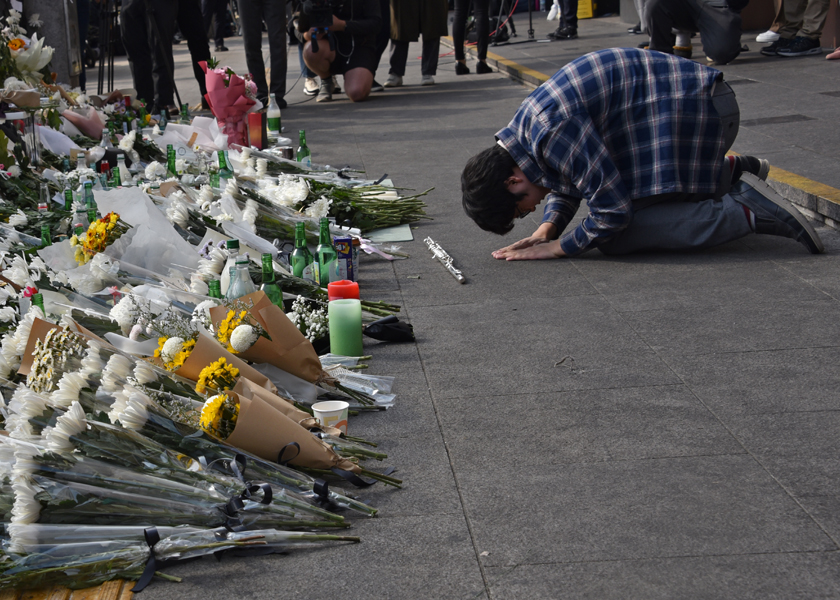
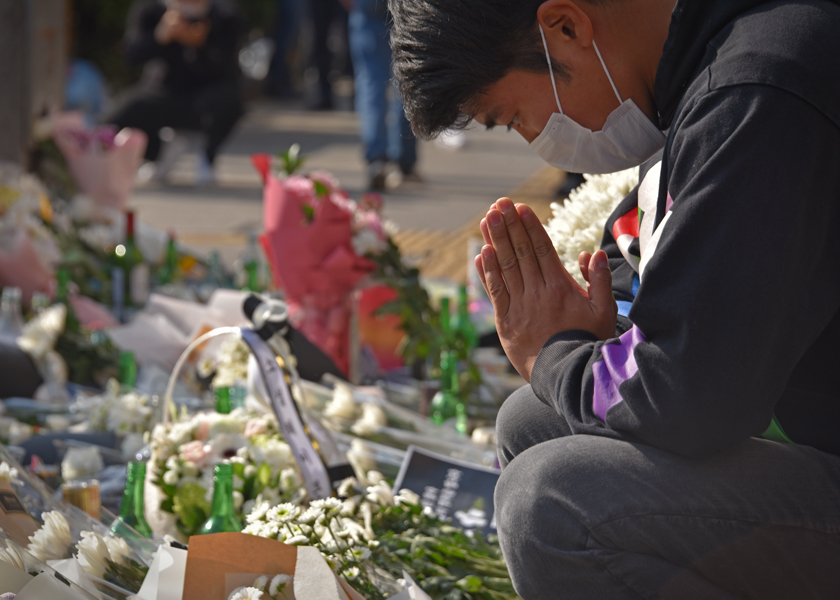
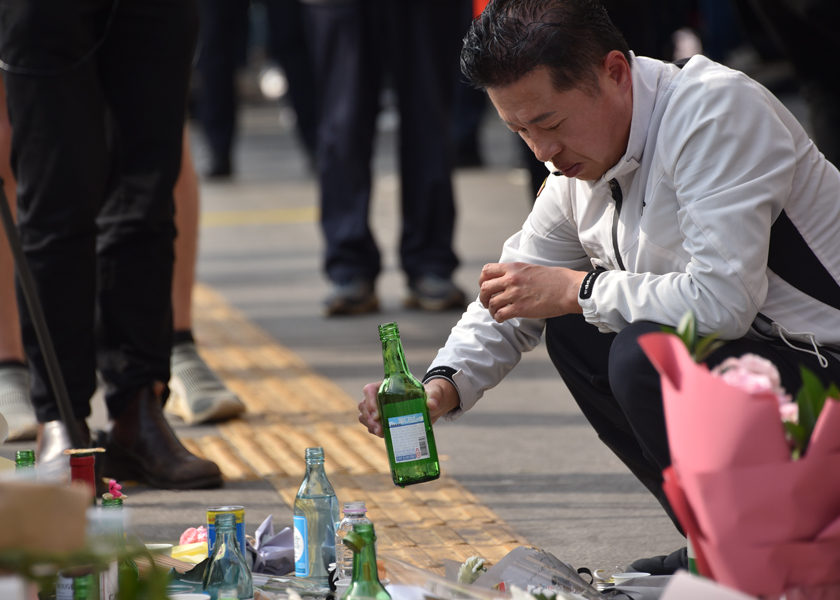
The government moved swiftly, as it always does regardless of political party, to respond appropriately, or at least look like it. The police chief of Yongsan District, which includes Itaewon, was fired on Wednesday evening. A special investigation team raided eight emergency service and government offices and headquarters. The ministerial press releases about financial recompense came across my news desk several times on Tuesday and Wednesday. Pledges to reform emergency response and crowd control guideline emanated from every governmental ministry and agency that might tangentially be culpable.
I certainly hope that something can come of this, some substantive change that doesn’t completely sterilize what makes Korea Korea, but does make it a safer version. As much as I would love to see a blitz of firings and a flurry of wrongful death suits, a part of me believes that, despite the warnings, no one genuinely fathomed it could happen here; not in the home of the beloved BTS Kpop stars and Oscar-winning director Joon-ho Bong, the land of world-class public transit and world-beating internet speeds. Nobody imagined it could happen until it was too late.
I suppose the point I’m belaboring is that while the videos are alarming enough to induce vicarious trauma, the start of that evening was not much different from the usual Halloween weekend. Perhaps the crowds were denser, but it was still calm and festive. How could this lead to such a terrible tragedy? But over the course of Saturday night, one of South Korea’s biggest peace-time disasters transpired after snowballing from conditions not much different than the crowd I had experienced the night before.
My Friday excursion came to a stifling and exhausting end as I finally made my way through to the end of the street after a claustrophobic 45 minutes of working my way out of the neighborhood into a wider, less crowded area. Fed up with the whole ordeal, I declared my intention to go home and veered off on my own.
As I walked along the sidewalk on the main road, which was busy but not as suffocating as it would be the following night, I thought about how I used to enjoy Halloweens in Itaewon; the sights, the sounds, the costumes and the crowds. And about how, now age 32, I finally feel like I have grown too old for this shit, having subconsciously begun avoiding the crowded, overly-enthusiastic street parties in exchange for the quiet safety of a sparsely-populated bar that lets me put on Bruce Springsteen, an option that grows more and more appealing to me as I get older in Seoul.
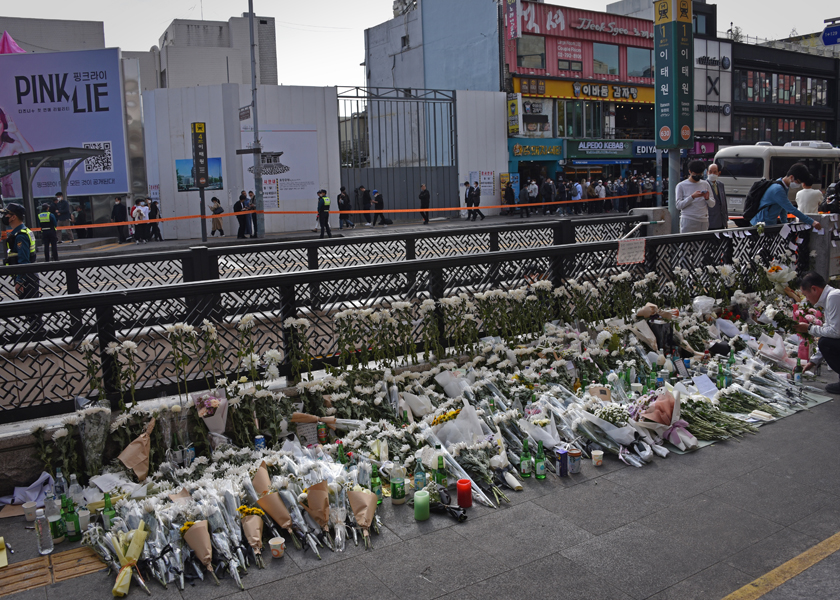
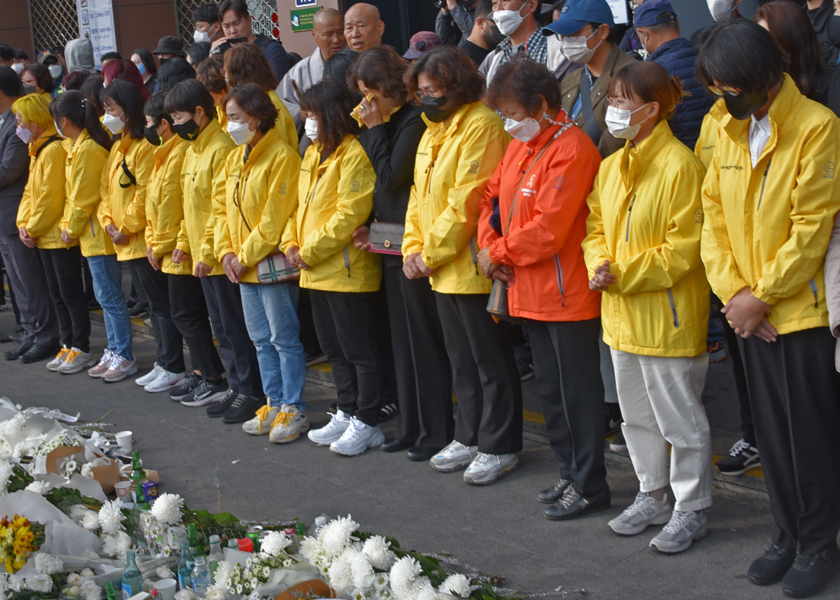
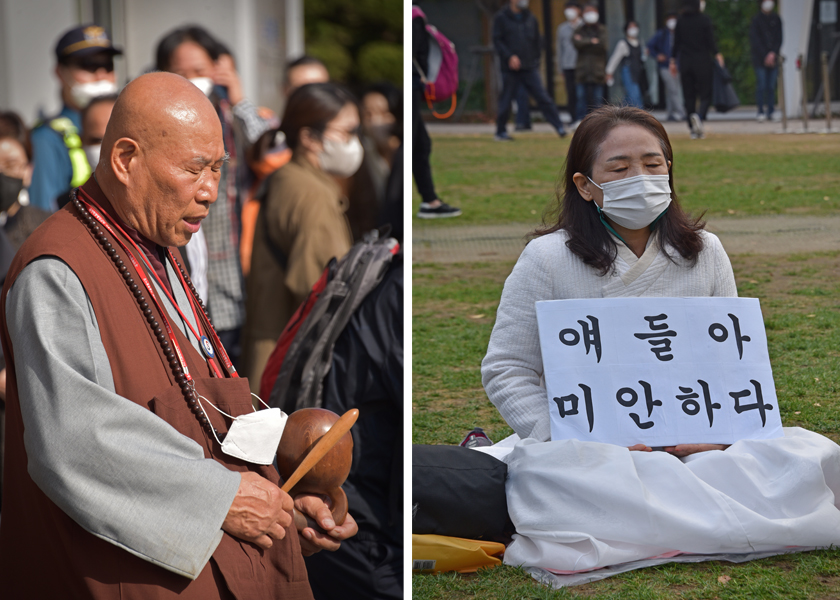
And that is the real tragedy of Saturday; of the 156 victims so far, 116 were in their 20s or even younger and some 90 percent were younger than 40. They won’t get to sit around with friends and reminisce about the bad decisions they made for the sake of a wacky experience, or laugh about what they considered fun when they were younger.
They will never have the chance to learn the lesson I learned and that most of us as the years pass, that they should have been able to carry with them into old age. They should be able to think back and fret about their children on the weekends the way their parents worried about them on Saturday.
Instead, the nation, and maybe the world, is learning that lesson on their behalf.
All we can do, then, is whatever we can do to ensure that other young people have the chance to grow old. We need to take this experience to heart as we pick up the pieces of our broken ones and strive for a better tomorrow.
Documentary film Land of My Father explores the symbolism of Dokdo to Koreans today | By Martha Vickery (Summer 2020 issue)
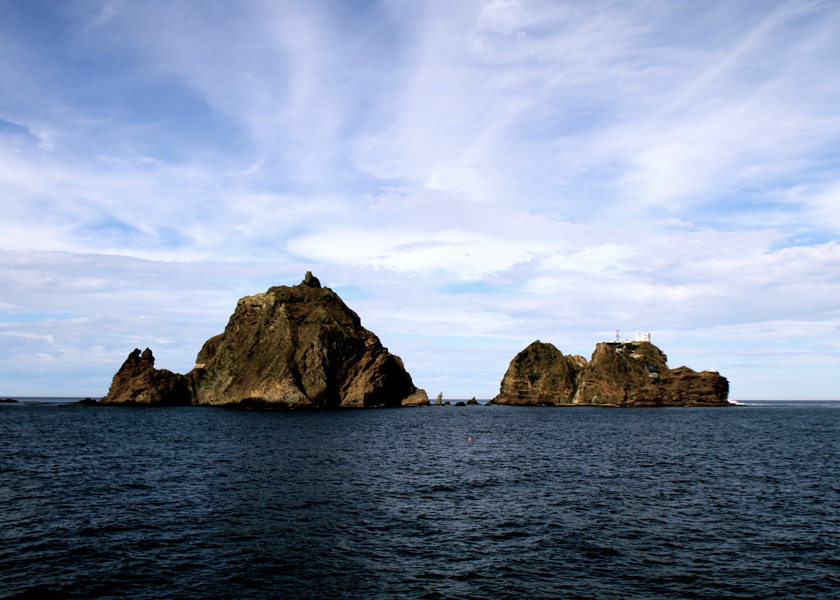
A month after premiering his documentary Land of My Father at the virtual 2020 Minneapolis-St. Paul International Film Festival, Minnesota (see film review) filmmaker Matthew Koshmrl was still waiting to hear whether he could go to South Korea in August or September to see his film at the Jeongju International Film Festival (JIFF). The JIFF selected the film for the festival this spring, but there was no word on whether the films would be shown in a virtual format due to ongoing restrictions necessitated by COVID-19, or if there would be an in-person festival to attend and actual people to meet.
It has been inconvenient, to say the least, to premiere a new independent film in the middle of a pandemic.
Land of My Father is about a very Korean topic —- the controversy between South Korea and Japan over the ownership of a pair of tiny islands called Dokdo, which dates back to Japan’s seizure and occupation of all Korean territory starting in 1910. Japan went on to conquer and occupy many other Pacific Rim countries until it was defeated in World War II. The occupation of Korea and other nations and territories ended with the surrender of Japan in 1945.

Koshmrl and collaborator/editor Christina Sun Kim have shown the Dokdo claim controversy (or Takeshima Islands, as Japan calls them) in a fresh way, highlighting the symbolism of Dokdo as the last Korean territory to still be claimed by Japan, and how this symbol has become central to the lives of South Koreans today. In a larger sense, the film explains the importance of Dokdo as a symbol of Korean autonomy and independence.
Under current restrictions, going to South Korea requires a mandatory two-week quarantine in South Korea upon arrival. Koshmrl is up for it. “It was seven years in the making, so to wait two more weeks to do this is pretty minimal, really,” he said. The Jeonju film festival is “a dream festival” to get into for any film; it is a large, international festival with a wide appeal to the public and the film industry.
At the same time, Koshmrl is forging connections with organizations for screenings outside festivals, including the Korean Association of Minnesota, which expressed interest in having an in-person screening after pandemic restrictions are eased. A Korean Association of the southern states, and the Korean Association of Houston have also expressed interest in a screening and filmmaker talk.
When he is not working on his own films, Koshmrl works as a cinematographer on other people’s films. He spent part of the summer at the U.S./Mexico border filming at some immigrant detention sites as part of a filming crew. These days, he is spending most of his time in his home town of Chisholm, Minnesota, a northern region of the state known as the Iron Range. He is also working part-time on a new film about the history of families like his, the mainly Eastern European immigrants that relocated to the mining towns on the Iron Range in the early 20th century.
Since Land of My Father was paid for through grant money and self-financed, Koshmrl said there is no urgent need to get the film sold as soon as possible. “The point was never to get it out there to make money off it, so I am fine holding and waiting for a good time for people to see it,” he said. Koshmrl has made several short films; Land of My Father is his first feature documentary.
After graduating with a film degree, Koshmrl lived in Daegu, South Korea from 2009 to 2012 to work and to study more about documentary filmmaking. His interest in the topic of the Dokdo Islands initially stemmed from his complete ignorance of the topic, he confessed. He was initiated into the history in a spectacular way when he came across a street demonstration in Korea by Korean War veterans during which ring-neck pheasants, a national bird of Japan, were beheaded onto an old imperial rising sun flag of Japan.
“It was very sensational, and I just didn’t understand it… I had no context for thinking about the Japanese occupation of Korea.” Like many westerners, Koshmrl found the symbolism of the tiny islands difficult to grasp. On the face of it, the dispute about these tiny rocky islands seemed puzzling and trivial. He decided then that if he did a master’s level film degree, Dokdo would be his thesis project.
In 2012, he entered a master’s level program at the University of Texas at Austin, and by 2015, he was ready to do his thesis film. To complete the film, he knew he would need a bilingual film editor. Koshmrl was referred to Christina Sun Kim by a University of Texas professor who had taught her, and had hired her as an editor for one of his own films. After the fact, he learned that she also had a good understanding of conversational Japanese, which was an added bonus in editing the footage shot in Japan.
Kim was also born in Minnesota, but moved with her parents to South Korea at age five, and returned to the U.S. when she was a seventh grader. Although she had a “truly bicultural upbringing,” she also needed to dig deep to understand the pain of the generation that lived through the Japanese occupation. She found she was able to fill in some of the cultural gaps. “That was very important to Matt, to have an editor who had a full understanding of the language and also had a Korean cultural background,” she said. “He saw that that was important right from the very beginning.”
Before starting the film project, Kim said, she had last been in South Korea in 1996. Notably, she did not witness the growth of advocacy by the former comfort women and former forced laborers and the awareness of the Dokdo territorial issue that emerged in South Korea during the ‘90s and early 2000s. “I felt like I was an outsider to Korea as well, when we started the project,” she said.
With a grant from the University of Texas, Koshmrl took a four-person grad student film crew to Daegu for a few months for the initial filming in 2015, and made two shorter return trips in 2016 and 2019.
It was 2016 before Kim started watching the raw footage. When she was finished, Koshmrl had someone to talk to about it. “It was an incredible experience,” Koshmrl recalled. “I suddenly felt like I was out of the silo.”
Not every documentary filmmaker uses a film editor, Kim said, the addition of another person who knows the material can contribute significantly to the project. “Once you have a collaborator you can inject a freshness into your vision,” she said, “and you may end up making a better film that is more faithful to your original idea, in my opinion.”
At first, Koshmrl said he wanted to do a broader film about the Dokdo issue. In the end, Kim and Koshmrl pared 350 hours of footage taken over three years, covering five possible characters. It became a 75-minute film that follows just two Dokdo activists: Kyoung-sook Choi and Byeong-man Noh, who coincidentally, were both inspired to their advocacy for Dokdo by their own fathers’ stories.
The two “painfully” decided to omit a third character from the film, Kim said. The character was a student whose back story as a North Korean refugee was compelling. That left the film with two middle-aged characters whose fathers lived through the war and occupation. Koshmrl wanted a next-generation character, a younger person who also believed in the importance of Dokdo and would carry on the legacy into the future.
They finally settled on Choi’s daughter Hyun-byul. “We thought that Hyun-byul actually is a better representative of someone from the younger generation developing that heart-connection to the place,” Kim said. The connection to Dokdo is more removed for the generation that did not live through the war or occupation, “but in Hyun-byul, we kind of saw that evolution of how the idea becomes a real thing —- we pursued that.” Over the course of a couple years, Hyun-byul grows into a deeper understanding of the significance of her mother’s work. Kim and Koshmrl capture several significant conversations between the two.
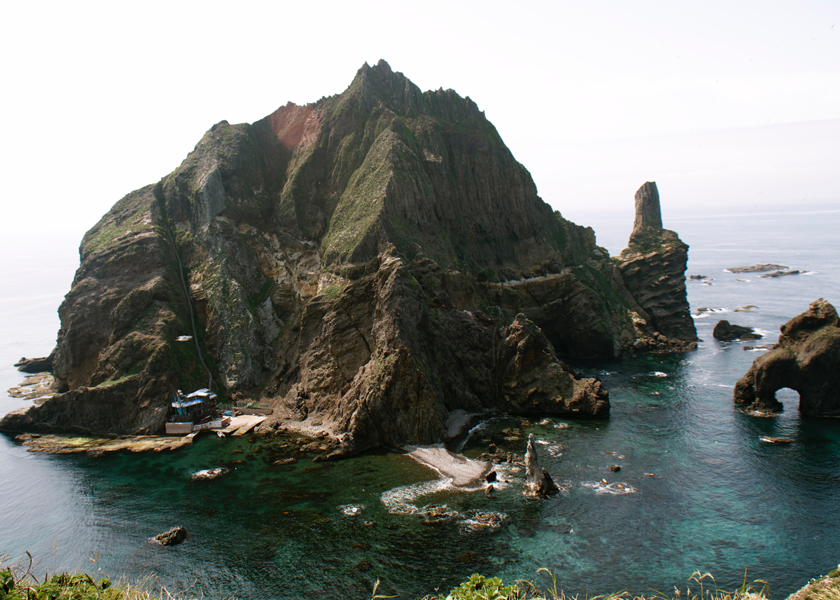
The film concentrates on two people, but Dokdo itself is also an enigmatic character. Unique, alone in the East Sea, Dokdo rises out of the ocean, the top of a mountain sticking its highest peak above the surface. Like its geography, Dokdo seems to hide much more than it reveals. Koshmrl and Kim discover that the heart of the story is the significance of that place in other people’s lives, much more than the facts of the dispute between Japan and Korea about the territory itself.
As Choi relates in the film, she had lived with her father as a resident of Dokdo in the ‘60s and ‘70s, when a small fishing village was established there. Since the early ‘90s, there are no residents and the South Korean government maintains the island as a natural preserve. The film follows Choi’s efforts to have her father’s residency on Dokdo officially recognized by South Korea, and to educate about Dokdo history and her father’s place in it.
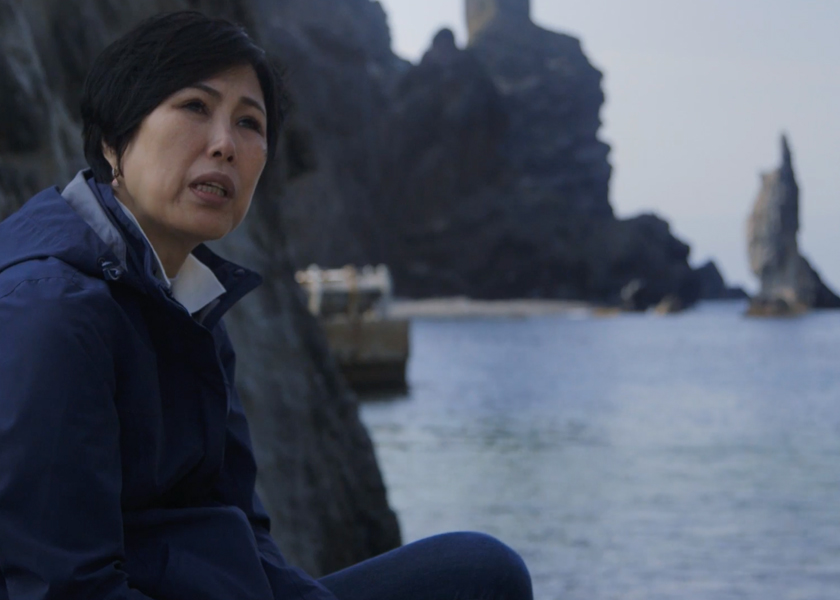
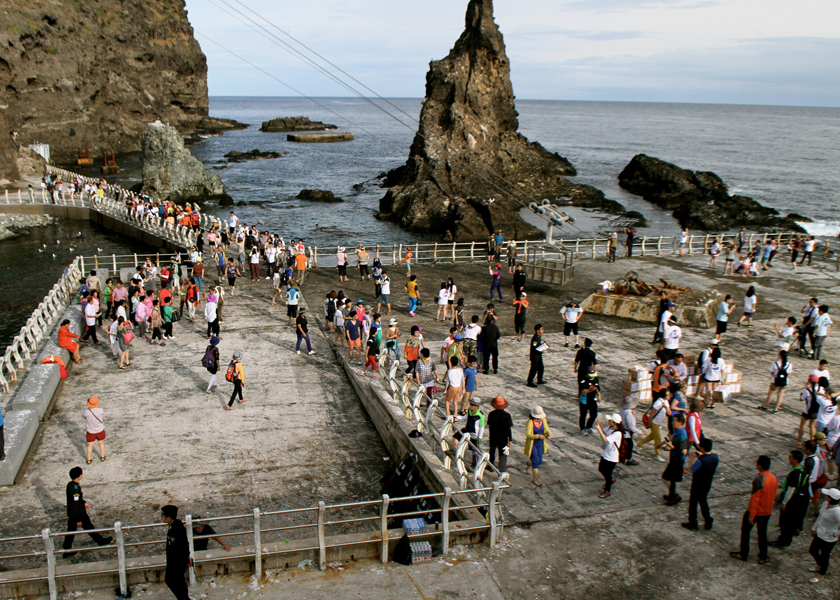
The film follows Choi’s work as a tour guide to Dokdo, which requires a two-day trip by boat, because it is so far to the east of mainland Korea. Depending on the weather, the boat sometimes cannot risk landing at the Dokdo wharf. When it does, visitors can only stay a half hour.
Byeon-man Noh, a farmer from the southern city of Namwon, was inspired to advocate for South Korea’s Dokdo claim because as an adult he learned that his father had been forced into slave labor by Japan, the fate of an estimated 725,000 Korean young men of that time. He was worked in a coal mine in Japan under inhumane working conditions; included in the film are photos of the painfully-thin Korean laborers who were often worked and starved to death.
Former slave laborers are one of the survivor groups that have advocated for an apology and reparations by Japan. However, Noh seldom demonstrates with any group. Instead, he regularly travels to Japan to demonstrate by himself in front of the Japanese legislature in Tokyo. He wears a traditional white Korean outfit with political messages written on it, shouting in Korean that Dokdo belongs to Korea and brandishing a sign written in Japanese. To Noh, Japan’s claim of Dokdo ownership is as false as its past claim on other Korean territory, and as false as its claim to the bodies of slave laborers and military sexual slaves from Korea.
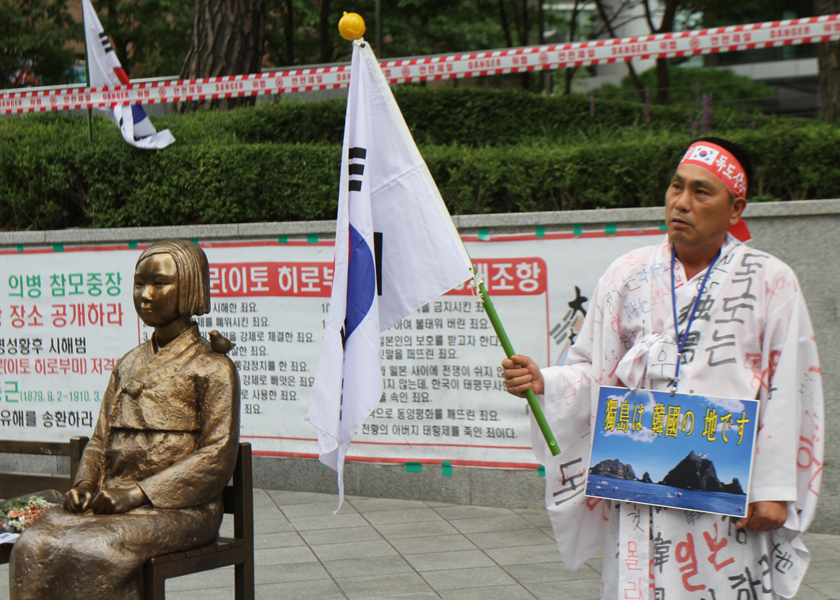
Koshmrl notes that viewers have had a variety of reactions to Noh’s tactics as shown in the film. Particularly American viewers, he said “think he is totally sensational and hurting his cause for being sensational. But others see the police around him, suffocating his protest and feel total empathy for his disenfranchisement,” he said. He has seen friends cry when they see his lonely protest, while others “simply think he’s crazy.”
Koshmrl employs an observational documentary technique known as cinema verité, which typically involves amassing a lot of footage over a long period of time. The filming is done with little or no direction, and the story is put together during the editing process. Kim watched the film footage for a year, part-time and between other projects before she was ready to edit, she said.
Embarking on the editing phase, Koshmrl said “I knew the themes I wanted to explore,” but since the editing process took four years “I had to evolve with the film and the way I thought about Dokdo. …I was really interested in the passing down of this history, how to memorialize the generational trauma, and I was also interested in how to memorialize an atrocity without indoctrinating hate.”
Interviews of people on the streets of both South Korea and Japan are striking in the film because of the contrasts. South Koreans seem informed and have an opinion about the Dokdo claim issue; but in Japan, passers by are vague on the topic. The idea of Dokdo “still affects people’s lives, and it is very much a part of life for the subjects of my film. I don’t think that is true of any Japanese person,” Koshmrl said.
That Japanese people are hazy on aspects of their own country’s history is not unique to Japan, Koshmrl pointed out. “I think we are going through something in the U.S. right now where the majority of the public are not educated on the black experience in the U.S., and what the Civil Rights movement was about,” Koshmrl observed, adding that it has to do with who controls the telling of history.
The Japanese government has notably attempted to control the telling of their history even outside of Japan, such as the incident in which the mayor of Osaka in 2018 condemned the memorial to the former comfort women before its unveiling in San Francisco and cut his city’s “sister city” ties to San Francisco in retaliation, Koshmrl remarked.
The film also includes a short clip of a speech in which the Japanese Prime Minister Shinzo Abe states that the generation of Japanese born after the occupation should not be made to apologize for the actions of their nation before they were born. Abe’s attitude about Japan’s war legacy and its affect on the Korean people continues to be contradictory, Koshmrl said. He has sometimes apologized for war crimes such as military sexual slavery, “but a week later he will say it was all voluntary. …they will admit and then deny in a very confusing way.”
There is also a short clip of a speech by Moo-Hyun Roh, when he was South Korea’s president, in which Roh notes that Dokdo was the first Korean territory to be occupied by Japan. Kim said the occupation of Dokdo preceded the occupation of other Korean territory because it was a military post for Japan during the Russo-Japanese War. That it should be the last place to be ceded formally to Korea makes Dokdo even more important to the war legacy, she said.
The lives of the two activists are shown as uneventful on a day-to-day basis. In one sequence, weather prevents Cho’s tour from taking off to Dokdo from the nearby island of Ulonggdo, and some of the tour participants are impatient with the delay. At one point, there is a mix-up with her permit to stay on Dokdo for more than the allotted 30 minutes. She works hard, but her efforts are often frustrated due to government permits and controls.
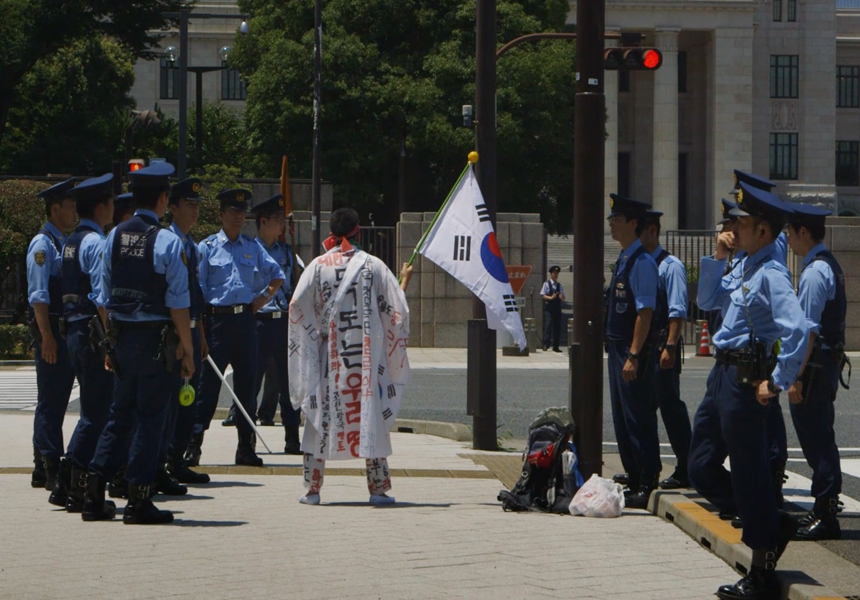
Noh is shown in his daily life, patiently trimming trees in his orchard, and going through the repetitive tasks of farming. He travels, uncomfortably and anonymously, to Japan to do his protests. Intermittently, police surround him, forcing him to shout his protest from behind them. He speaks no Japanese, and is frustrated at not being able to communicate with his minders. At one protest in Seoul in front of the Japanese Embassy, he is arrested and bundled into the back of a police car for trying to deliver a written message to the embassy door.
The pace was intentional, Kim said. “Mr. Noh’s and Mrs. Choi’s lives really haven’t changed much. …that is really what it is.” Choi is still fighting with the government over her father’s legacy and her right to live on the island with very few new developments.
Noh’s campaign continues on —- he calls himself an “egg” against the “boulder” which is Japan. He cannot hope to win, he says, only to be destroyed and make the boulder a little dirty in the process.
As observers, Kim said, she and Koshmrl learned a lot about the Korea-Japan dispute over Dokdo, and “we both sort of concluded that this fight is ongoing and will never end. Between the two countries, Korea has their own narrative about the war and occupation; Japan has its own narrative. …I feel like we hope there will be a dialogue and better relationship between the two cultures at some point, but it seems like this issue will just continue.”
At the beginning of this editing assignment, “I wasn’t fully convinced that Dokdo was a living symbol of the legacy of the occupation, forced labor sexual slavery and all of that. After doing the film, now I am,” Kim said. The people of that generation are now dying out, she said, and as time passes, there are fewer eyewitnesses to Korea’s occupation. The one witness that will be standing after the generation is gone may well be that lonely pair of islands, she said, and its symbolic meaning in the hearts of the next generation.
The Land of My Father website (www.landofmyfather.com) will post updates of future screenings, to be determined, and with links to paid downloads that will be available from film festival websites.